Exploring the Hidden World of Solidification: How Gold-Germanium Nanoparticles Transform
The process of solidification is a fundamental phenomenon that shapes materials from metals to ice. However, at the nanoscale, this transformation becomes even more intriguing. Our research explores the solidification pathways of tiny gold-germanium (AuGe) alloy nanoparticles, revealing unexpected phases that challenge classical scientific understanding.
Why Study AuGe Nanoparticles?
Nanoparticles are the building blocks of modern technology, from electronics to medical applications. Understanding how they solidify helps scientists engineer materials with superior properties. The AuGe system is particularly interesting because it is a eutectic alloy, meaning it has a unique melting point where both gold and germanium solidify together. By cooling these nanoparticles under controlled conditions, we observed surprising new phases forming within them.
Uncovering Metastable Phases
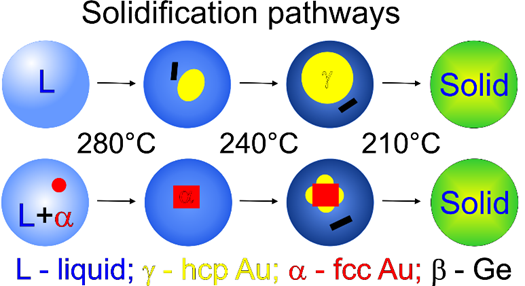
Using advanced electron microscopy techniques, we directly observed AuGe nanoparticles as they solidified. Instead of following the classical route, some nanoparticles formed an unexpected hexagonal close-packed (hcp) gold phase—something never seen before in this system. These new structures only appeared when the nanoparticles were highly undercooled, meaning they remained liquid far below their normal freezing temperature before suddenly crystallizing.
How Does This Change Our Understanding?
Traditionally, metals solidify into well-known structures, but our findings suggest that nanoscale systems can take alternative pathways. The presence of this hcp gold phase, coexisting with other phases, hints at new ways to manipulate material properties. This knowledge could lead to better catalysts, more efficient electronic components, and novel nanostructures with tailored functionalities.
The Future of Nanoscale Solidification
By continuing to explore these unusual phase transitions, scientists can develop more sophisticated models to predict and control how nanoparticles behave. Our study provides a stepping stone for future research into metastable materials, opening the door to advanced applications in nanotechnology, electronics, and beyond
Acknowledgements.
This research was supported by the National Science Centre, Poland, under project No. 2021/43/B/ST5/00320.